

retired engineer, former sailor, off grid, gamer, in Puerto Rico. Moderating a little bit.
- 5 Posts
- 11 Comments
 3·2 years ago
yes captain
 1·2 years ago
Engineers describe heat transfer with a “heat transfer coefficient”, and the rate of heat transfer is this coefficient multiplied by the temperature difference. So you can calculate what the heat transfer coefficient must be by measuring room air temperature initially, water temperature initially, and then running your system for a little while and measuring the room temperature again. The smaller room area you can cool the more accurate this will be. You will need to look up heat capacity and density of air (easy to find), and the temperature change of the air with the volume of the room and the temperature change will together give you an amount of heat you removed from the air to the water. Simple!
I built it to fit some glass that was about the right size, so not really a design others would emulate precisely. But a standard sheet of galvanized sheet metal is about three feet by six feet, so four 10-foot boards will nicely make the “box”. I used 1x2 for the corner bracings (just glued and screwed), window frames, and dryer trays. I had made an earlier version with a sheet of translucent corrugated roofing for the lid, and that heated up quite well, too. The legs were just some scrap - I think the angle of the box should be around 45 to achieve some natural convection and good mid-day sun collection area. But it could vary with one’s latitude I suppose - in a more northern clime (I’m at 20N), a more vertical “cabinet” might work - the dryer trays would be shallower, but convection would be better. I am not sure the vent stack makes any difference.
I rotated 90 right and the picture was 180 from OP, so I rotated back 90 left and tadaa:

I tried disabling Privacy Badger - that sometimes interferes - but no help
I guess, but cannot tell for sure; I did not rotate the pic from the time I took it until I posted. One can “preview” a post, but once you click preview you cannot back up to make edits (at least with my configuration - Firefox on Ubuntu Linux) - browser back button does not work. A mystery!
yes, a vent stack; it helps air flow. There are three two-inch (5cm) holes at the bottom end to admit air. An earlier iteration of this design had screens over the holes to keep critters out, but it turned out to not be an issue so we have not screened the holes on this unit.
We saw a design for a solar dryer popular with Peace Corps volunteers - a heat-collector box with a small dryer compartment on top and three little trays in a stack. But I thought, why not put the dryer trays right inside the heat collector? I just checked the temperature and with partly-cloudy skies, it is 50C in the box.
maybe there is a way to rotate images, but I have not yet discovered it; sorry about that. It looked OK as an original. Once you preview, it is not possible to edit? I am noob.
I do not aspire to make screws or wires, though there are those who do (and whether or not they are in their right mind, is certainly an interesting debate). But I regard them as things that have been artfully (if extremely rapidly) made, and I try to appreciate the convenience of NOT having to make them myself! :D (hey, no emojis?)
actually, you better wait for the pics to say that . . .
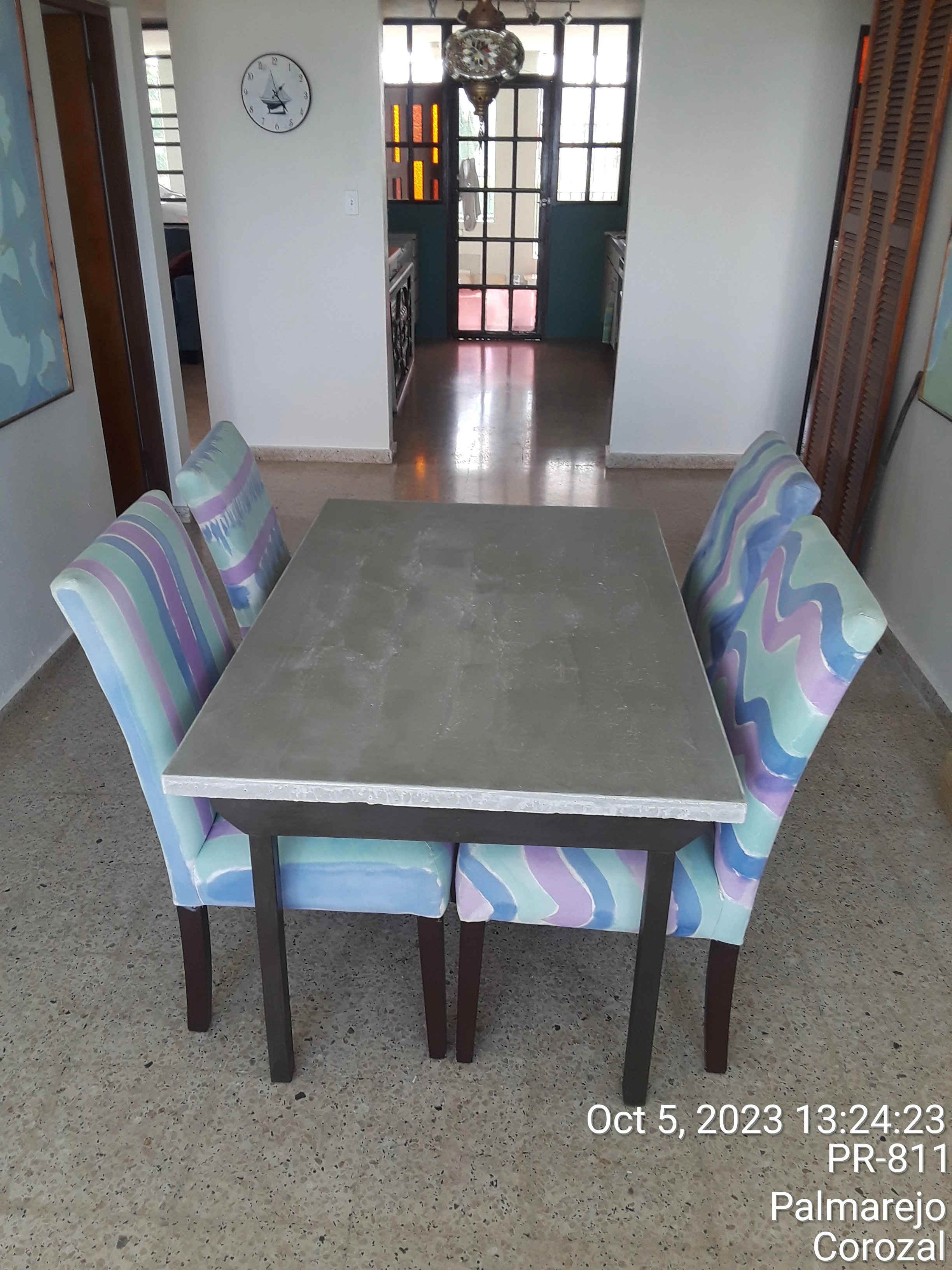
top slab is about 230 or 240 pounds. Wood base is only about 15 or so; light. I made no attachment between the concrete and the wood - just gravity.