
7·
6 hours agoThe difference is that violence from the bourgeoisie is directed against the vast majority of society to keep their parasitic profits, while revolutionary violence deposes this system and liberates the working classes.

Actually, this town has more than enough room for the two of us
He/him or they/them, doesn’t matter too much
Marxist-Leninist ☭
Interested in Marxism-Leninism, but don’t know where to start? Check out my Read Theory, Darn it! introductory reading list!
The difference is that violence from the bourgeoisie is directed against the vast majority of society to keep their parasitic profits, while revolutionary violence deposes this system and liberates the working classes.
The tail does not wag the dog. Israel has some counter-influence, but is ultimately a puppet state for the US Empire.

This seems more based on capitalist-realism than on practical analysis. The US Empire is on its way out, and with it will go Israel.
Israel is a US millitary base in country form, all of its genocide is committed with the express approval, support, and material assistance of the US Empire.
Israel isn’t going to last forever, the illusion of its indestructability has been destroyed and the resistance’s bravery and courage in resisting the entity are known around the world. Palestinians will not cease until Palestine is free, and Israel is going to crumble as more settlers flee and investments dry up.
Not at all wierd, China has been a strong supporter of Palestinian liberation for over half a century, and Muslims in China are quite happy. I’m assuming you’re referring to the western allegations of genocide in Xinjiang, though there’s pretty much no actual evidence for it. The best and most comprehensive resource I have seen so far is Qiao Collective’s Xinjiang: A Resource and Report Compilation. Qiao Collective is explicitly pro-PRC, but this is an extremely comprehensive write-up of the entire background of the events, the timeline of reports, and real and fake claims.
I also recommend reading the UN report and China’s response to it. These are the most relevant accusations and responses without delving into straight up fantasy like Adrian Zenz, professional propagandist for the Victims of Communism Foundation, does.
Tourists go to Xinjiang all the time. You can watch videos like this one on YouTube, though it obviously isn’t going to be a comprehensive view of course.
The 1950s, where the US Empire committed genocide against Koreans (on both sides of the parallel).
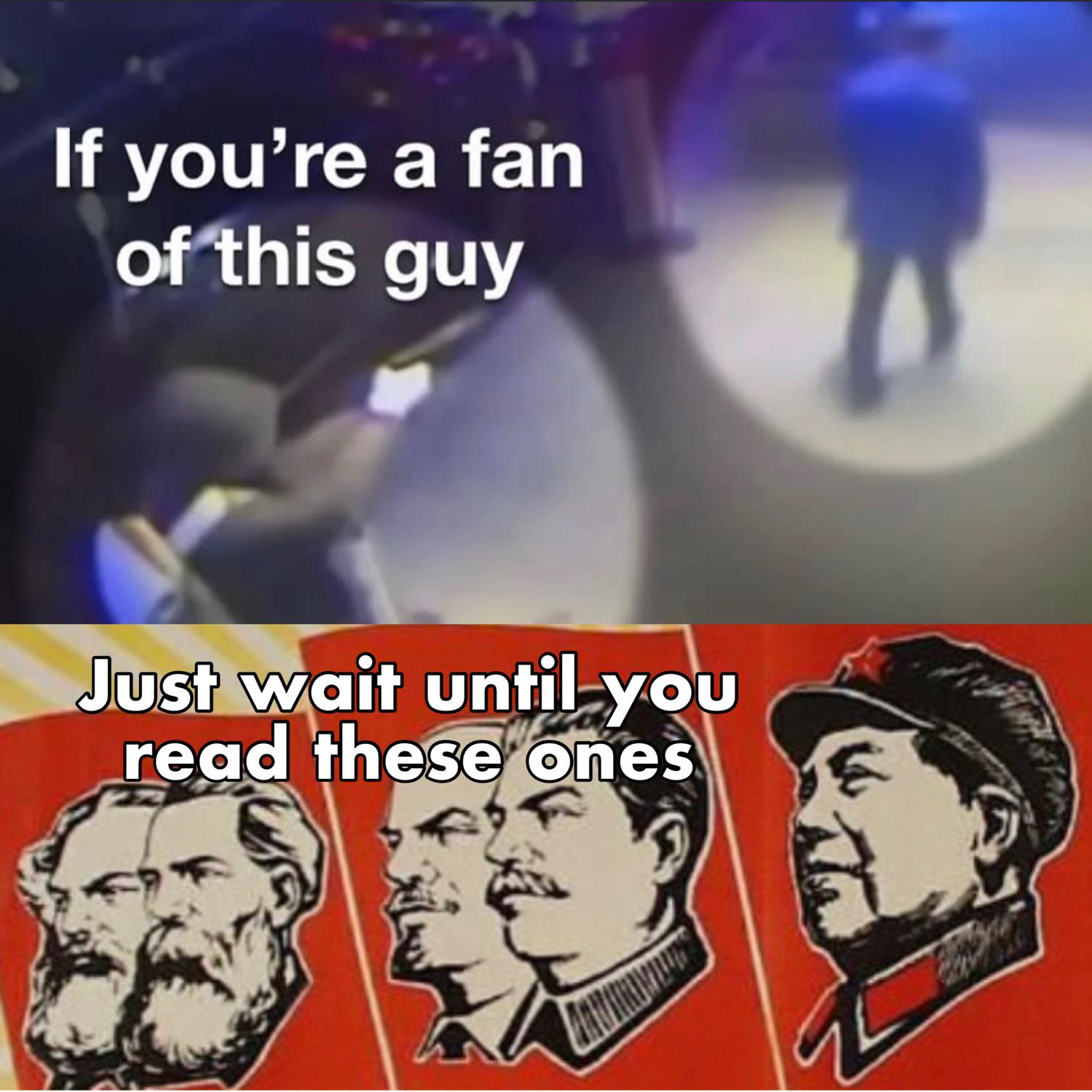
Marxism-Leninism is the ideology that has liberated billions of working people around the world. It makes sense to uphold the ones who put the teachings of Marx and Engels into practice and synthesized Marxism-Leninism, not just Marx and Engels themselves. The “Five Heads” of Marx, Engels, Lenin, Stalin, and Mao are seen as the most important contributors to the actual real ideology that has been put into practice to liberate billions in the former USSR, China, Cuba, Vietnam, Laos, and many more countries.
Even returning to the subject of this post, dialectical materialism, Lenin wrote Materialism and Empirio-Criticism and Stalin wrote Dialectical and Historical Materialism. The former is an in-depth look at dialectical materialism and how it stands up to bourgeois science, and the latter is an easily understood primer meant for those who wanted to grasp the basics.
You haven’t read the sources I linked either. We have a western academic, state funded, and based on your arguments here there’s what you believe evidence that causes you to describe the USSR not as socialism, but a kleptocracy. This is why I’m heavily skeptical, because I have read on the structure of the USSR, I know how it functioned, and it was unquestionably socialist. I’m not saying no corruption ever existed, I’m saying that corruption was nowhere near relevant enough to be the base mode of production, because that’s an absurd statement to begin with.
The advent of socialism in Russia democratized the economy, doubled life expectancy, dramatically reduced poverty, provided free, high quality healthcare and education, had assured jobs and free or low cost housing, over tripled literacy rates, and turned a feudal backwater into a spacefaring nation in just a few short decades. Wealth disparity, which you seem to place an over-emphasis on, was dramatically lowered as compared to the Tsarist era and the capitalist era. The economy was based on collectivized production and distribution, and fulfilling the needs of everyone.
When you have all of that undeniably true, then statements like “Russia wasn’t socialist, it was a kleptocracy” become silly. Of course there was some degree of corruption, every country has some level of corruption. The USSR wasn’t a perfect utopia, as the first socialist state there were missteps and struggles. However, it was absolutely socialist, and because of that it delivered incredible results for the working classes.
Not just any public university employee:
Financial support for this research was provided by a number of foundations and organizations, including the National Endowment of the Humanities (NEH), the National Council for Eurasian and East European Research (NCEEER), the Archives and Library of the Hoover Institution for War and Peace at Stanford University, the Kennan Institute of the Woodrow Wilson International Center for Scholars, and the Open Society Archive (Budapest). His first book was Inventing a Soviet Countryside: State Power and the Transformation of Rural Russia, 1917-1929 (2004).
There’s a concerted effort within western academia to keep demonizing socialism, and funding is one of the ways the state keeps that going. I provided more than plenty sources given an alternative view. None of this is about me trying to “out-socialist” you, nor virtue signal nor purity test. It’s about trying to come to a consistent understanding grounded in reality, from a proletarian point of view, rather than accepting liberal framing of socialism.
Yes, you indeed linked a US Federally funded liberal historian that is paid to present a certain view of the USSR. If you want sources on the socialist economy of the USSR, and how it was run, here are some great ones:
All much better sources.
I don’t own Marxism, correct. I also study it a great deal, organize in real life with a communist party. I do acknowledge real faults with the USSR and PRC, but I don’t acknowledge fake ones. You should read the essay I linked called China Has Billionaires, it explains China’s position as an early socialist economy and its process of gradually collectivizing production and distribution. The class that controls the state and holds the principle aspects of the economy in China is the proletariat, as it was in the USSR, as it is in Cuba.
You defining Cuba as more correctly socialist because its rich people are poorer is what I mean by you being anti-Marxist, this poverty fetishism isn’t Marxist in the slightest.
I’m not being absurd, you are. You’re defining the mode of production of a majority collectivized and planned economy that was oriented towards satisfying the needs of everyone as a “kleptocracy.” This is ridiculous and requires an extreme level of evidence explaining why such a focus was both put on satisfying everyone’s needs, and on this “kleptocracy” you claim. You’re confusing the capitalists that rose from the ashes of the USSR with the USSR’s mode of production. I’m aware that China has billionaires, and again, you seem to be under the impression that Marxism is about equalitarianism and not about gradually collectivizing production and distribution to satisfy the needs of everyone.
Good reading for you would be China has Billionaires. Marxists don’t deny the struggles of the USSR and PRC, we do learn from them, what we don’t do is dismiss their successes or take liberal perspectives on them like you’re doing here.
I’m aware that you consider yourself a socialist, but your analysis is far from that of a socialist.
Socialism is not the absence of wealth. Every state has mixed forms of ownership, but the principle aspect is what’s dominant. The USSR did not have “oligarchs who stole from the people,” they had a socialist economy oriented towards satisfying the needs of everyone. Free education and housing, healthcare, dramatic improvements in infrastructure, huge increases in living standards, all came from the socialist system. Same for the PRC, though their safety nets aren’t as strong. This idea that socialism is about equalitarianism is exactly why you’re being anti-Marxist, Marx railed against equalitarians.
Cuba has a very similar structure and economy to the USSR and PRC, with their own characteristics. The main difference is that they are much smaller and much more cut off.
It’s the opposite, I’m a dialectical materialist, and am focused on pragmatism. Your assessment of the USSR, PRC, etc is idealist in nature and looks at the state not as by its class character, but as something beyond class. This confusion leads you to see administration in a socialist economy as “kleptocracy.” Same with your analysis of the PRC, conflating the presence of private property with the absence of socialism. Erasure of dialectical materialism, and looking at components of an economy outside of their context within said economy is closer to metaphysics and a rejection of Marxism.
Libertarianism often arises organically, though, not just from the outside. It arises due to class interests. People can manipulate this, and do, but the origins are ultimately petty bourgeois ideology.
As for the USSR, it was a socialist economy, not an “oligarchical kleptocracy.” The economy was democratically run and centrally planned, with public ownership as the principle aspect of the economy. This is straightforwardly socialist.
The PRC does not celebrate “capitalism.” The usage of markets and mixed forms of ownership for small and medium firms subservient to the public sector is a form of socialist market economy. Public ownership is the principle aspect of the economy, and the working classes democratically control the state.
Latin American socialism is great. Cuba is a standout example, and Venezuela and Nicaragua are increasingly socializing. They are under constant siege, but are nevertheless rising.
Ultimately, I’m not sure what you think socialism is for you to have this view so contrary to Marxism.
I’ve definitely heard a few, like the Stalin one, passed around by anti-communists.
Libertarianism isn’t driven by the haute bourgeoisie though, that’s currently more neoliberalism and fascism. Libertarianism is primarily driven by people that own HVAC companies with a dozen people, and these people can be steered by Thiel types but ultimately by numbers its the small business owners pushing it.
As for Marxism, Germany post-reunification was a return to fascism, not socialism. The gains achieved by the socialists in the East were erased, officials excised in show trials, and erased. Socialism has been achieved already, in the former USSR, and today in the PRC, Cuba, Vietnam, and more. Public ownership is the principle aspect of their economies, and the working classes are in control of the state. I think you’re dramatically misanalyzing socialism right now.
The DPRK doesn’t have a massive international propaganda network, though. Support for the DPRK outside the DPRK comes from analysis of the DPRK, not from propaganda.
Is the DPRK an empire?








I made an introductory Marxist-Leninist reading list if you want a place to start, FYI