

181·
5 months agoAgain, scientists used AI to develop a viable bacteriophage genome. To say AI did it is confusing.
Again, scientists used AI to develop a viable bacteriophage genome. To say AI did it is confusing.
How do you track gender category when it is not listed or asked anywhere on the forums?
Got it via their website jumping over walls. From October 2023, not that that diminishes it’s sting.
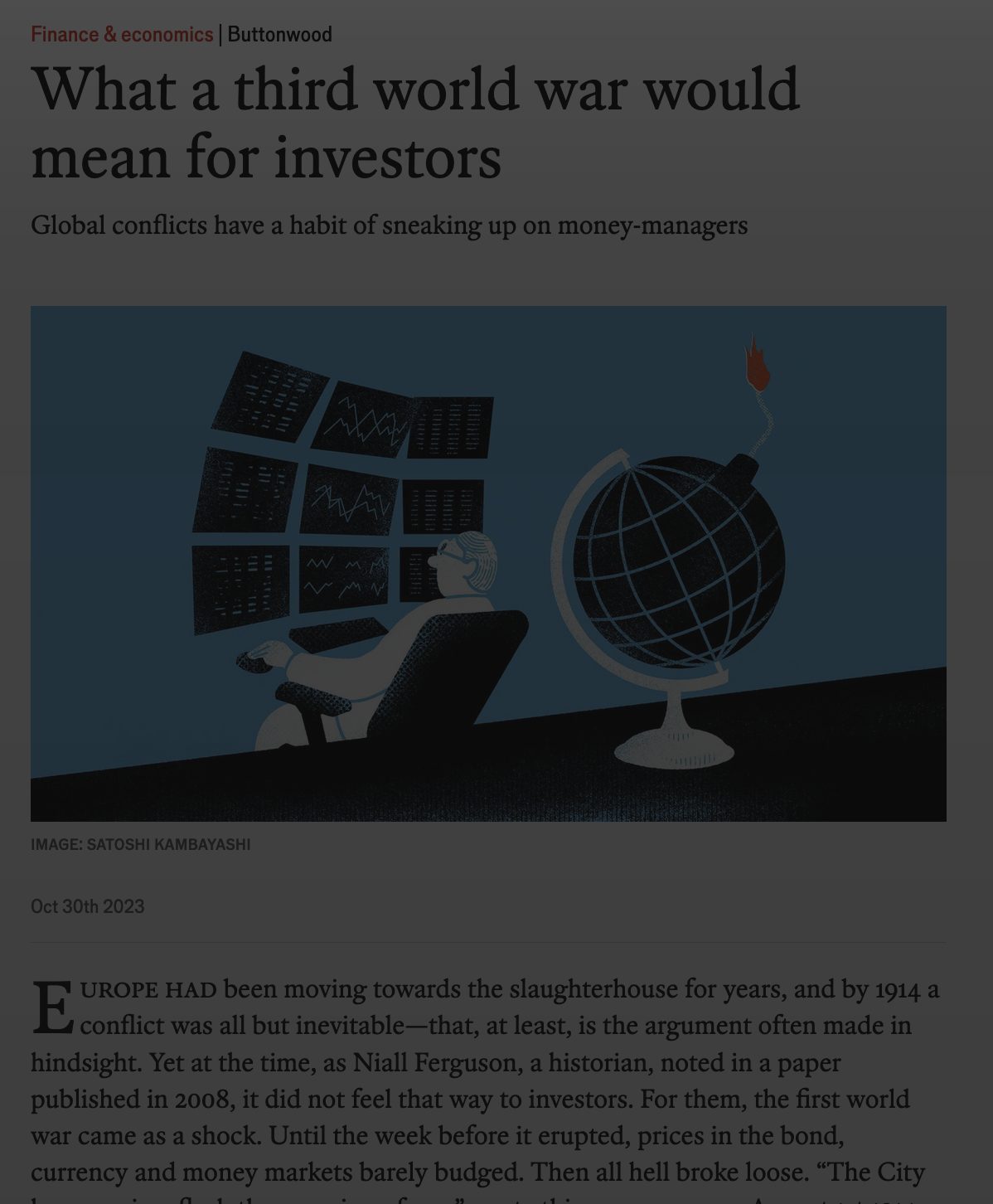
Is that top right image from a real Economist post or it is edited? I did not find it by simple search (search is so sloppy of late).
Edit: Link to article.
Europe had been moving towards the slaughterhouse for years, and by 1914 a conflict was all but inevitable—that, at least, is the argument often made in hindsight. Yet at the time, as Niall Ferguson, a historian, noted in a paper published in 2008, it did not feel that way to investors. For them, the first world war came as a shock. Until the week before it erupted, prices in the bond, currency and money markets barely budged. Then all hell broke loose. “The City has seen in a flash the meaning of war,” wrote this newspaper on August 1st 1914.
Could financial markets once again be underpricing the risk of a global conflict? In the nightmare scenario, the descent into a third world war began two years ago, as Russian troops massed on the Ukrainian border. Today Israel’s battle against Hamas has the frightening potential to spill across its borders. American military support is crucial to both Ukraine and Israel, and in Iraq and Syria the superpower’s bases have come under fire, probably from proxies of Iran. Should China decide it is time to take advantage of a distracted superpower and invade Taiwan, America could all too easily end up being drawn into three wars at once. The rest of the world risks those wars interlocking and turning into something even more devastating.

It is as if it is a general rule at this point that centralization breeds corruption. No matter how many statements people make early on in social engagements, centralization leads them to screw people depending on these systems. When making long term commitment to anything, check if it is centralized or how easy it is to unshackle yourself from it.
I think this is something most people rarely talk about but it strikes home to many of us. As a parent, I have a responsibility to defend my children against this persistent cognitive manipulation and experimentation. Just as I would not want a random stranger at the corner have exclusive attention of my kid and sell them insurance or grammarly or mesothelioma, I would also never want them to have that unfiltered access to my kids online. One can then say AdBlocks are a parental obligation.

Luddites were not as opposed to new technology as you say it here. They were mainly concerned about what technology would do to whom.
A helpful history right here: https://www.hachettebookgroup.com/titles/brian-merchant/blood-in-the-machine/9780316487740/?lens=little-brown
Findroid/Finamp? Quite robust.
Searching for almost anything was so much easy. Such a powerful tool that disappeared. Its performance 20 years ago was better than Finder is today. At least from my experience.
Used to be the first thing we installed on phones and PCs. Opera was blazing fast on basic phones as far back as 2008sh.

Sadly, yes. One would hope the more core sectors use it, the more the general population would use such tools. But alas!
Cold plain metrics can easily hide social complexity.
Assume 10 investigative journalists use modded privacy-friendly Firefox for year long investigation. Then their report is read by 10 million average news reader on stock browsers like Chrome. Network logics tell us that Firefox browser has asymmetrical value in the ecosystem than plain usage metrics can ever reveal.
The obsession with numbers (the more the better) is a major blinding effect in societies driven by hierarchical cultures.

The article itself focuses on a Palestinian who has gon ethrough the whole wringer for decades. It is not a distraction, at least that is not the intention. It is a deeper look into history to locate what today feels like new stuff for the world yet this is how “Gaza breathes”, away from Hamas and ISIS and Israel.
I find the diaspora conflicts irritating. Most of them fan killings back in Ethiopia, Eritrea, and Sudan then create such a bitter environment in the communities hosting them (like Calgary or Sweden or Germany). Tell these people to go and fight in the Ethiopian fronts and they coil back. But they want the kids of poor farmers to go and die for their abstract ideas (sometimes genuine, but mostly misdirected at the wrong people).

Interesting seen this way.
Word of note though. Salaries are quiet spread out. The people likely to buy new iPhones are likely people earning top 1% of salaries in most countries in Africa.
If this viz is focusing on average salary, then it is a general description and should not be compared to other countries with different income spreads (min-max). It can be quite deceptive. Upper middle class in a place like Kenya or Myanmar live a far more better life overall than say lower middle class folk in the US.

The Federated Learning of Cohorts and now the Topics API are part of a plan to pitch an “alternative” tracking platform, and Google argues that there has to be a tracking alternative—you can’t just not be spied on.

The problem with defending the purity of the English language is that English is about as pure as a cribhouse whore. We don’t just borrow words; on occasion, English has pursued other languages down alleyways to beat them unconscious and rifle their pockets for new vocabulary.
–James D. Nicoll
You may like this essay on why English has weird spellings. Think technological timings.
https://aeon.co/essays/why-is-the-english-spelling-system-so-weird-and-inconsistent
Ka-no. Why waste so many letters. :)


It is not enough to talk of an alternative if the underlying structure reinforces centralization. This is so especially when federation protocols are active and seeking adoption.