I don’t think this post was written by ChatGPT. I do think the human who wrote it uses ChatGPT so much they’re adopting its mannerisms.
ex arch user for 5 yrs
current fedora user since 2024
i’ve been getting a lot of “recommended” youtube videos on gentoo and nixos
send help plezz
The first time debian oldstable broke a package after an incremental update, i reconsidered my long running hard stance against arch
Updated my endeavour install last night from 6.18 to 7.1 without issue: daily -Syu is for the birds
Arch user (btw) here. I use xorg and a custom tiling window manager. I had 0 breakage regarding my config. Nvidie fked me 2 times and grub was broken 1 time. Thats it. 10 years 3 chroot. Pacman runs when I feel like it. I used two weeks to configure my setup, and I hardly ever change a thing nowdays.
Tried Hyperland on an “old” thinkpad, each update broke something. So no thanks, I’ll stick to mature, battle tested components, where my config and sanity will remain stable, and leave the tamagotchi for ricers/thinkerers.
Stable over rolling release?
These are not mutually exclusive.
Can haz stable rolling.
E.g. use Gentoo, and avoid the ~ and ** keywords.
Gentoo’s all about choice. You can choose to configure it so it does not require hand holding, and running it like a tamagochi. Or you can choose to fiddle with it so much it’s very time demanding… not the compiling, so much as the system configuration management. There’s official binhost now anyway. But then, if you’re fiddling around alot, you’ll send emerge to compile rather than just get a binary, to meet all your exacting nuances of configuration.
I have one gentoo that’s been rock solid for … about 17 years, with only one blip of downtime when there was a fire. No hand-holding.
Arch is indeed a different beast. In my experience, it’s only a matter of (relatively short) time before Arch eats its kernel or some other catastrophe that requires rescue or abandon.
Respect to Manjaro for what they try do, offer arch with more stability (and conveniences).
On a whim, just now, I made this

But, then, I hear many things have changed in arch, since I last used arch (just before the switch to systemd)… and maybe things have changed, and it does not do that any more…?
`
And then also, can haz arch/artix/etc in a bedrock stratum… then it can carry on in its bloody rolling risky churn, in a safe space, where the more stable strata can pick up the slack when arch tries to faceplant itself again.
ChatGPT-ass take
The ChatGPT accent is real.
Went the other way, moved from Mint 22.3 to OpenSuSE Tumbleweed. Rolling release with solid testing before updates are pushed, any breakage during testing and they don’t push that day’s update, and if something does slip through and break things, just boot into the pre-update snapshot and wait a day to try again with the next patches.
Up to date packages with low hassle, so as long as I don’t need stable-as-in-never-changes, it’s great.
Also, nice to have KDE 6 finally and to have KDE not be a forgotten afterthought (Cinnamon is nice but I always feel like I’m limited compared to KDE)
I actually tried Tumbleweed briefly before settling on fedora. I got the nvidia drivers and everything, but it was just an oddly buggy and slow experience for me. Kinda made me sad cause I’ve heard so many good things about it. Not blaming the distro at all don’t get me wrong, I know I’m a bit dumb so I always assume its a me problem before I start throwing blame at the distro. I might try it again when I get an amd gpu maybe.
Does this include Cachy? I’ve had it for months now after years of distro hopping and it’s been great
For servers ways. For laptop today after last air attack. I know air “isn’t” arch. But without it arch has a lot less packages.
I’m not one of those Arch evangelicals, but this isn’t true at all now.
I am, and you’re right, but my server’s still running Debian
100%. I’ve got servers running arch for the past 5 years or so and they’re the most stable systems I’ve got. I got so tired of the painful upgrade paths on “stable” distros so decided to switch a server to a rolling release.
After I found arch got security patches into the repos faster than the stable distros could backport, I decided to switch them all over.
I’m even a mad man and have them self update with a script that checks informant (or something, can’t actually remember) for installed packages against news. If no installed packages are found in news, it continues with the scheduled update.
It’s glorious.
I fully endorse gentoo and arch in prod
Especially when customizing the kernel is the default experience with Gentoo, reducing the theoretical attack surface even more if you know what you’re doing.
I was too lazy for scripting the update to check the news and just get a mail when the update has issues… or should get one.
In reality I check if the email process still works once every blue moon because I didn’t get one from a failed update in years.
If you want to have at least some thrill, use testing repos. I had to fix GitLab two (2) times due to the main package not being linked against testing libraries (it took 10 seconds to ln -s the new to the old version), and had one breakage due to dovecot revamping their whole config system, but publishing no example/useful docs.
But it says this screenshot post happened 4h ago.
Did the internet lie to me?
It still says 4h ago. I checked a while ago, still the same. What the heck? Is it moving in time? Always four hours away? How is this possible?!
There might be a bug in your time, check the logs
Ask fusion researchers, they’ve been maintaining a 30 year difference for decades.
Why should my pc be stable if I’m not stable
wanda.jpg
I have questions now, about myself
Nothing is stable in this world nowadays.
So neither my distro nor my orientation.
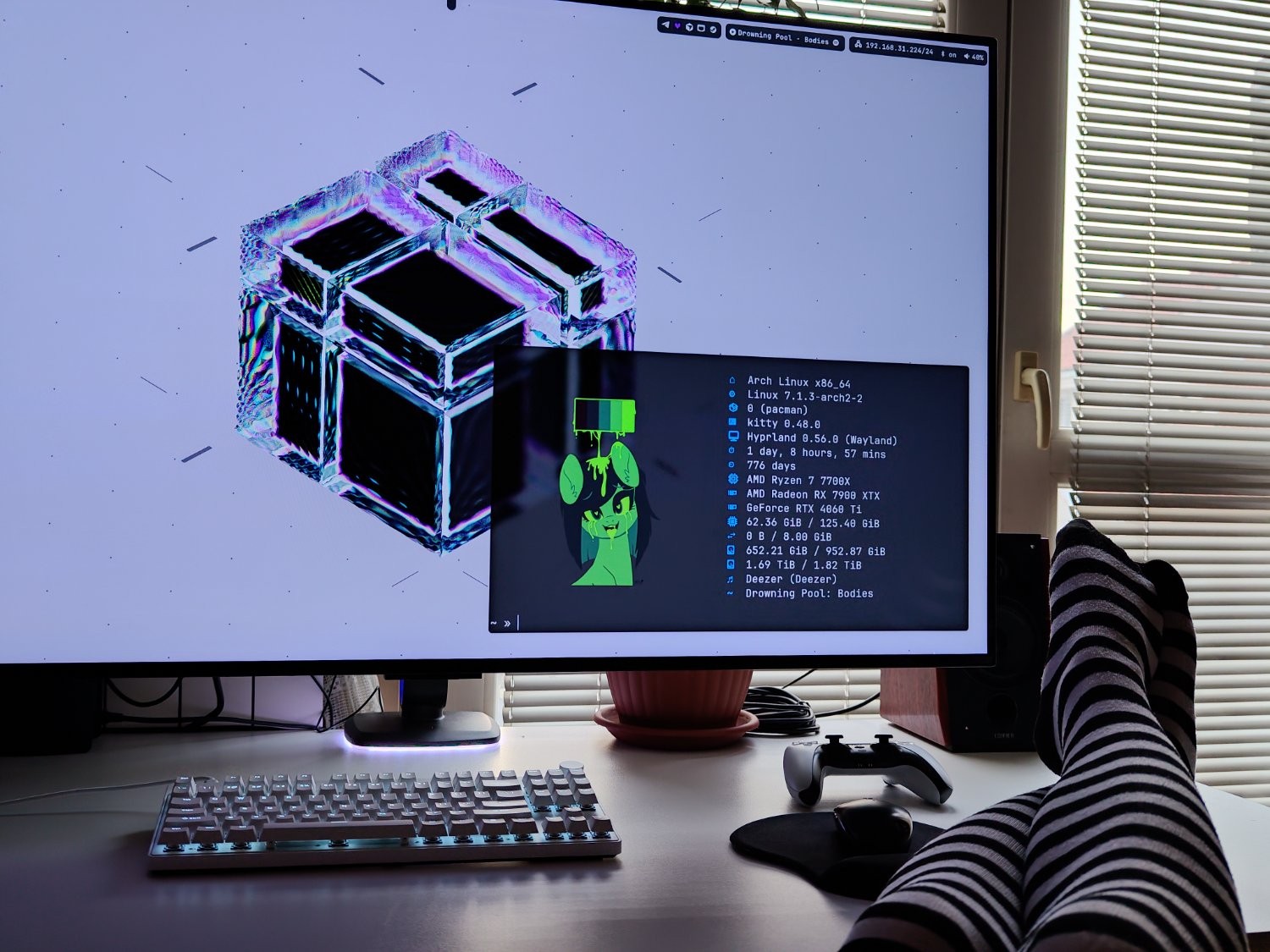
I boot my arch laptop once in a blue moon and update it. Its not 2002 anymore.
Ironically, it’s the rolling release that’s much more stable for me.
“Stable” distros often had a long and risky process of upgrading to the next major release.
Meanwhile, my Arch install has been pretty damn stable for over 10 years and went through several different PCs.
“Stable” distros often had a long and risky process of upgrading to the next major release.
But you only do that once every 3-4 years, and you have months to carefully plan ahead.
Meanwhile,
pacman -Syucould just provide you a major breaking multi-package upgrade of, say, your desktop environment on any random Tuesday. And then your only options are to either roll the dice and accept that update right then, and deal with all the breaking changes it may introduce, or not receive any updates at all, including security fixes, until you do.I use Arch myself, and it’s been pretty troublefree the past 2 years or so, but it was pretty rough around the Plasma 6 release, and there have been other rough periods as well, like when there were bluetooth/wifi and amdgpu regressions in the kernel.
You’re confusing two different meanings of stable. When people refer to “stable” distros such as Debian, they are referring to the meaning of stable as “unchanging,” not the meaning of stable as “doesn’t crash.”
A rolling release distro by that definition cannot be stable.
TBF “doesn’t crash” is generally why LTS-distros do “unchanging”.
Same, and next year when bcachefs has nailed down the kinks it’ll be basically bullet proof with snapshotting prior to its daily updates.
Sure bcachefs sounds like a pretty good idea, especially since the author thinks his AI coding assistant is sentient and a “her”. What is it with file system maintainers and mental illness…
From what I know, the AI Assistant is the least of Kent Overstreet’s problems. If anything it’s a blessing he’s fixanting on a random number generator instead of risking becoming Hans Raiser 2.0.
it seems there’s elevated adverse behavior in people who work on things that combine deep hardware and software in general. see jailbreaking, emulation, hyprland, something
proof is in the pudding as they say. sounds like you have your own issues.
Why bcachefs over btrfs?
I’ve been on ZFS since CachyOS made it easy to use.
https://bartosz.fenski.pl/modern-fs-benchmark/ benchmarks say it all.
Sadly those benchmarks only tell me that they did test only two file systems on LUKS…
Fair, I’m always scared to upgrade to a new Debian release and the process is always painful. But that happens every couple years and I can take a week or two to look into it before doing it.
Every time I did pacman -Syu it was a Russian roulette. Most of the times everything was fine, but often enough there was a problem and something was broken and I had to spend a couple days figuring out what was the problem.
I always just rollback then wait until I feel like they might’ve pushed an update to fix it.
I’m always scared to upgrade to a new Debian release and the process is always painful.
At least in my personal experience this is one of the big triggers for distro hopping. Most of the people I know that stuck to one distro for years and years are on a rolling release.
I mostly run Debian on servers. I do not want a rolling release on a server, at all. I don’t care how well they check their packages, I just want the thing to work. I do not care about new features, I just want it to work.
I’m only still on tumbleweed because I’m too lazy to reinstall…
That’s my point. A version upgrade having issues would have forced you to do it by now.
You upgrade?
I wonder how many Arch haters have actually used Arch and ever ran into a breaking issue.
In my 8 years of daily driving Arch, I have had 1 ever, and it was only bad bc I didn’t know of BTRFS yet.
That happened 3 years in, and I went on a new distro-hopping spree in between, trying Fedora, NixOS, and others, and they had actual problems. Not “oh an update broke my system and was fixed in a day.”
So now I’ve been back on Arch for more years.
This whole “Arch is always breaking and takes so much maintenance” is a myth. In reality, Arch is the most stable, because it packages everything Vanilla. Everything works the “standard” way. On Debian, things decay, and then some stuff that’s new breaks with some stuff that’s old. On Fedora, there is a Red-Hat tax: configs in weird places, strange scripts, software missing from main repos (COPR sucks btw). On Arch, it’s just “normal” Linux; and that works
This mirrors my experience. I -Syu on a weekly basis, spend about 3 minutes doing pacnews, and then I’m done.
Yeah, I’ve noticed there’s this subsection of people that have a completely wrong understanding of what the term “stable” means in the world of distros, and that it often creates as many problems as it solves, particularly on a desktop PC, or even worse, a gaming PC.
And for there record: Stable just means that things don’t change. That doesn’t mean it contains less bugs, is easier to use or is more secure. And on the flip side it doesn’t mean that distros that are not “stable” are necessarily “unstable” in any shape or form.
Well… because of longer testing periods and a lot of stuff never even considered until stale the stable distros indeed have less bugs. The ones that still slip through however will basically not get fixes for years.
On the other hand I have seen a lot of bugs on Arch… but I usually don’t care and just assume (rightfully so in 99% of the cases) that they get fixed within hours.
Stable distros are great as targets for development, such as for containers. It also works great for end user environments because developers aren’t trying to hit a moving target in terms of core libraries.
For a home user, having something more stable isn’t very beneficial. If you want to have things stay the same for the next 2 years or so, then go for it.
It’s one of the reasons why fedora works well, it has just a 6 month release cycle, so nothing gets too stale. More modern packaging formats like flatpak and appimage are changing things a bit since they don’t rely on the system packages and can use something newer.
Interesting, my two friends with Arch keep breaking their system 😅 They say its not their fault though!
I wonder how many Arch haters have actually used Arch and ever ran into a breaking issue.
A lot… they install it, screw up because they didn’t bother to read the instructions, then did the usual… a new install.
Those who pass the first basic barrier to just chroot into the system and fix a simple mistake or roll back a package for the few hours it takes to get fixed instead of starting fresh usually stay for a long time…
In fact with the people I know there is a correlation between either “oh, I don’t bother to fix anything and just do a fresh install (that idea is especially persistent in Windows users)” or “there’s a big distro upgrade that had issues” and distro hopping. Once you settled on a rolling release and learned the basics in terms of fixing stuff the urge to hop yet another time vanishes for many.
“oh, I don’t bother to fix anything and just do a fresh install (that idea is especially persistent in Windows users)”
In fairness, not everyone who did that was just trying to avoid looking into things and learning the correct way. I can’t be the only one who had Arch on a system before getting a smartphone, so early days, that was my sole means of accessing the internet, so if it went down hard and I didn’t immediately understand enough of the error message to at least have an idea of man pages to give a read, I didn’t really have a whole heck of a lot else available to continue trouble shooting. These days, worst case, I can turn on my laptop or grab my phone and search things until I understand the issue and find a solution.
That said, nearly all of my system breaking issues were self-inflicted by trying to do things I didn’t fully understand, just because I thought the end result sounded cool, or not checking the news and unwittingly doing the exact thing the latest post was warning people to be aware of and not do with some sort of major upgrade/change in the base system.
I can’t be the only one who had Arch on a system before getting a smartphone
But that issue is solved for many years now. Although it makes a certain kind of sense: a lot of the Arch hate and memes causes we to question if that person has actually used Arch in years. So a lot of those ideas may be indeed ancient experiences surviving purely in memes and stories.
Oh, I wasn’t trying to excuse it now, just saying there was a time where it was a reasonable approach if you found yourself out of your depth and really just needed to have your machine up and running again, rather than stemming from someone having no desire to learn a better way.
Debian decays? Can’t relate, I’ve often been running Debian releases until they almost fell out of support (happens on servers) and they were always rock solid after I set them up. It’s only ever an issue if you want to run new software versions without some kind of virtual environment, and generally I just don’t care about that.
I think you can get problems once you are a full release cycle behind the last supported one.
Funnily enough it’s mostly an issue with mirrors and signing keys, so basically the same fix Arch users need if they are behind for many months: update the packages for keys and mirrors first, everyting else afterwards.
I’ve used my current install for at least that long (going back further with Antergos) and you’re correct about non-rolling options… I definitely would’ve had more pain with system upgrades and PPAs etc in those years.
That said, I think the Tamagotchi comparison probably makes sense in a way if it “dies” you probably did something “wrong” as on-paper it’s also not difficult to maintain a digital pet either.
I’m using an outdated system, it’s on three strikes:
-
Slow, shared internet for me. This adds friction to updates, and when I don’t update as frequently as Arch expects this is the breakage you won’t see.
-
I hate that updating today vs days-from-now might yield drastically different results. Admittedly the actual problem with my last few updates is that the reason-I-updated issues persisted.
-
The AUR is the biggest reason to use Arch. But use the AUR very carefully and not for system dependencies! Your graphics card is now legacy, so we put the driver on the AUR* ;)
Though I don’t think these sort of problems are unfixable**, and other rolling distros probably do fix some of them but may also not have as good of a packaging system as Arch.
For instance I’m trying Void Linux on an old machine and have already ran into 2 (non-default) applications missing dependencies (which might be an issue with package maintainers, but also Void doesn’t seem to track optional dependencies).
Tumbleweed/Slowroll would probably be a better fit for me, if not for Patterns.
* also if you update without switching, blank screen for you
** internet+GPU are also material problems as well, but those cannot get fixed today and probably will not be fixed next month either
-
Once I learned to make separate partitions for root, home, EFI, and then make routine backup of my package list, the update fears evaporate. Though with how CachyOS sets up btrfs snapshots by default now, it’d be pretty hard to deep fry an install beyond repair.
My machines got borked every time I tried to do a Debian or Fedora dist-upgrade following the official guide, like 4 times total. Rolling updates on Arch require manual intervention once in a blue moon and haven’t broken my system since I got rid of Nvidia
Ubuntu will actively break itself via
snapdat like 2am on a Sunday.Fedora could not do a fully system update on a 1GB VPS because
dnfwould OOM.The dumbest thing I’ve seen Arch do in over a decade of using it is put RabbitMQ in its official repos while also rolling the latest version of Erlang which RabbitMQ doesn’t support.
I have Arch (btw) on my laptop which is the tinkering machine that only I use, and a Win10/Linux dual-boot desktop which is the one other people use that I’m not allowed to break. I had Fedora Silverblue on there originally because I figured it would be pretty stable, but it honestly gave me nothing but trouble. I switched that one over to CachyOS and it’s been smooth sailing ever since.
I had nothing but trouble with Suse, Fedora and Debían on my nightmare of a machine (laptop with AMD/nvidia GPUs) and honestly thought that was my lot until I hit upon Arch, which I have been more than happy with for over 3 years now.
Same, but with an ancient Nvidia card even…
Isn’t Debian pretty clear that they don’t support upgrades and it’s likely to break if you try?
So I should just reinstall my system every two years? What is this, Windows?
🤷
I felt the same way and held my nose to dive in to rolling release as a result.
No, you may be thinking about combining repos from different releases aka frankendebian? That isn’t supported. Upgrades are definitely supported.
All I know is I was ready to go through the process to go from 12 to 13 and their documentation was full of disclaimers saying that it’s not officially supported.
I did my best, and it broke.
Can you show me this documentation? Debian famously takes great care to ensure a good upgrade path with thorough instructions, like here https://www.debian.org/releases/stable/release-notes/upgrading.en.html but a typical desktop user would just edit apt repos and dist-upgrade.
I’m 99% sure I was going with their official documentation, which you linked just there.
I can’t speak for what I read or how I interpreted it ~6 months ago, other than to say I understood upgrading was not supported and I was SOL that mine broke.
No, I’ve never used “sloppy backports” (as the only warning of lack of support I can currently find lists as a problem) and I knew that back then too, so that wasn’t the issue.
I remember them having this in the docs in the past, recommending a reinstall instead. But it seems that is no longer the case.
All I know is I was ready to go through the process to go from 12 to 13 and their documentation was full of disclaimers saying that it’s not officially supported.
I did my best, and it broke.